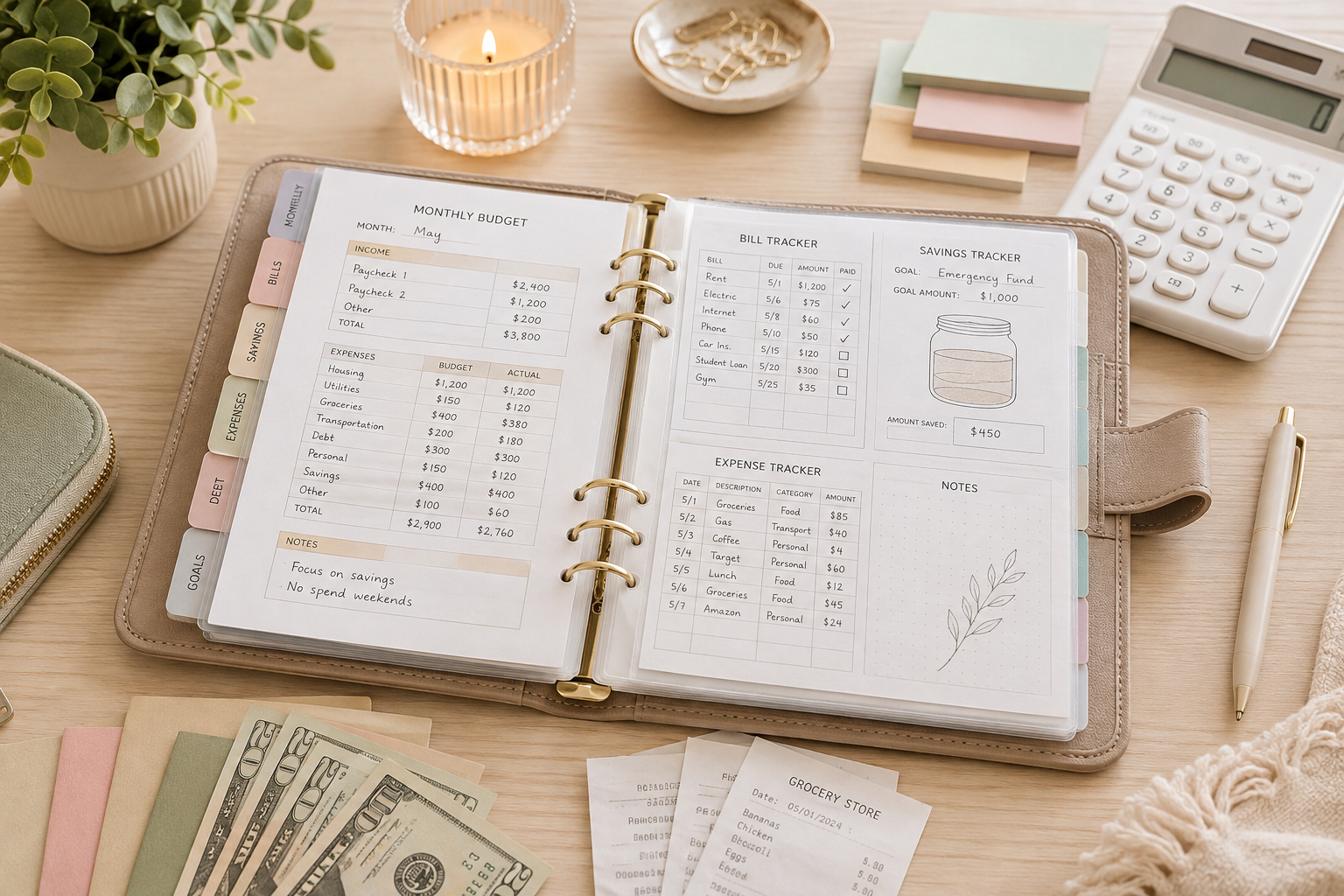


Saving money can feel overwhelming, especially when you are working toward a large financial goal. Whether you want to build an emergency fund, pay for a vacation, purchase a new car, or save for a home, a savings tracker can turn an intimidating goal into a clear and manageable plan.
A savings tracker helps you see exactly how much progress you have made, how much you still need to save, and whether you are staying on schedule. Instead of simply hoping there will be money left at the end of the month, you can create a system that keeps your goal visible and motivates you to continue.
Here is how to use a savings tracker to reach your money goals one deposit at a time.
What Is a Savings Tracker?
A savings tracker is a tool that records the money you set aside for a specific financial goal. It can be a printable page, spreadsheet, digital planner, budgeting app, or simple chart.
Most savings trackers include space for:
- Your savings goal
- Your target amount
- Your starting balance
- Your target date
- Individual deposits
- Your current balance
- The amount remaining
- A visual progress chart
The purpose of a savings tracker is not just to record numbers. It gives you a visual reminder of what you are working toward and helps you remain accountable.
Why Savings Trackers Work
Financial goals often fail when they are too vague. Saying, “I need to save more money,” does not give you a clear destination or plan.
A tracker transforms that general intention into a measurable goal.
For example, instead of saying:
I want to save for a vacation.
You could create this goal:
I will save $2,400 for a vacation by June 1 by depositing $200 each month.
Now you know exactly how much you need, when you need it, and how much to save each month.
A savings tracker also provides a sense of accomplishment. Each time you record a deposit, color in a section, or update your balance, you can see that your efforts are producing results.
Step 1: Choose One Specific Savings Goal
Begin by deciding what you want to save for. Your goal should be specific enough that you can assign it a dollar amount and deadline.
Common savings goals include:
- A starter emergency fund
- A three- to six-month emergency fund
- A family vacation
- Holiday gifts
- A wedding
- A home down payment
- A vehicle
- Home repairs
- Medical expenses
- College tuition
- A new computer
- Starting a business
Although you may have several goals, it is often easier to begin with one priority. Trying to fund too many goals at once can make your progress feel slow.
Write the name of your goal at the top of your tracker. Give it a meaningful title such as “Family Beach Vacation,” “Emergency Fund,” or “New Car Savings.”
Step 2: Set a Target Amount
Determine how much money you will need to reach your goal.
Research the likely cost and include related expenses. For example, a vacation savings goal may need to cover transportation, lodging, meals, activities, tips, and spending money.
Suppose you want to build a $1,500 emergency fund. Your savings tracker might begin with:
Goal: Starter Emergency Fund
Target amount: $1,500
Current savings: $200
Amount remaining: $1,300
Having a precise number makes it easier to calculate your monthly or weekly savings target.
Step 3: Select a Realistic Deadline
A deadline creates urgency and gives you a way to measure whether you are on track.
Choose a date that is challenging but realistic. Saving $5,000 in three months may not be practical for your current income, but saving it over 18 months might be achievable.
Once you have selected your deadline, calculate how much you need to save during each pay period.
For example, imagine that you want to save $1,200 in 12 months.
- Monthly savings needed: $100
- Biweekly savings needed: approximately $46
- Weekly savings needed: approximately $23
Breaking the total into smaller amounts makes the goal feel much more manageable.
Step 4: Choose the Right Savings Tracker
The best savings tracker is one you will actually use. Select a format that matches your habits and preferences.
Printable Savings Tracker
A printable tracker is helpful if you enjoy writing by hand or coloring in progress bars. You can place it in your budget binder, planner, or somewhere visible in your home.
Savings Tracker Spreadsheet
A spreadsheet can automatically calculate your balance, remaining amount, and percentage completed. It is especially useful if you want to track multiple financial goals.
Digital Savings Tracker
A digital planner or budgeting app may work well if you prefer tracking your finances from your phone or tablet.
Regardless of the format, your tracker should be simple to update. A complicated system can make saving feel like another chore.
Step 5: Break the Goal Into Milestones
Large financial goals can take months or years to complete. Milestones help you celebrate progress along the way.
If your goal is to save $5,000, you could create milestones at:
- $500
- $1,000
- $2,500
- $4,000
- $5,000
You can also divide your tracker into percentages, such as 10%, 25%, 50%, 75%, and 100%.
Reaching the halfway point can be especially motivating. It proves that your plan is working and that your goal is possible.
Step 6: Schedule Your Savings Deposits
Treat savings like a regular bill rather than something you do only when extra money is available.
Choose when you will transfer money to savings. You might make deposits:
- Every payday
- Once a week
- On the first day of each month
- After receiving commission or freelance income
- Whenever you receive unexpected money
Automating your transfers can make the process easier. When money moves to savings automatically, you are less likely to spend it accidentally.
Even small automatic transfers add up. Saving $25 each week would give you approximately $1,300 after one year.
Step 7: Record Every Deposit
Update your tracker each time you add money to your savings account. Record the date, deposit amount, new balance, and amount remaining.
A simple savings log might look like this:
| Date | Deposit | New Balance | Amount Remaining |
|---|---|---|---|
| January 5 | $50 | $50 | $950 |
| January 19 | $75 | $125 | $875 |
| February 2 | $100 | $225 | $775 |
Do not wait until the end of the month to update your tracker. Recording deposits immediately gives you a small sense of accomplishment and keeps your information accurate.
Step 8: Use Visual Progress to Stay Motivated
One of the biggest benefits of a savings tracker is being able to see your progress.
You might:
- Color in one box for every $25 saved
- Fill in a savings thermometer
- Add a sticker for every deposit
- Shade sections of a progress bar
- Update a percentage-complete chart
- Mark each milestone with a check
Place your tracker somewhere you will see it regularly. Keeping your goal visible can help you pause before making an unnecessary purchase.
You may decide that reaching your vacation goal is more important than another impulse purchase.
Step 9: Find Extra Money to Add to Your Goal
Your scheduled deposits provide the foundation of your savings plan, but additional deposits can help you reach your goal sooner.
Consider adding money from:
- Tax refunds
- Work bonuses
- Overtime pay
- Cash gifts
- Rebates
- Side-hustle income
- Items you sell
- Cash-back rewards
- A no-spend challenge
- Money remaining in your budget
You can also review recurring expenses and look for temporary reductions. Canceling an unused $15 subscription and adding that money to your savings would provide an additional $180 over one year.
Record every extra contribution, even if it is only a few dollars. Small deposits still move you closer to your goal.
Step 10: Review Your Progress Monthly
Set aside time at the end of each month to review your savings tracker.
Ask yourself:
- How much did I save this month?
- Did I meet my target?
- What helped me make progress?
- What made saving difficult?
- Do I need to adjust my deposit amount?
- Am I still on track to meet my deadline?
Missing one deposit does not mean you have failed. Your tracker is there to provide information, not guilt.
Adjust your plan when necessary. You may need to extend your deadline, reduce the target amount, or temporarily lower your deposits. A realistic plan that changes with your circumstances is better than abandoning your goal completely.
Keep Your Savings Separate
Consider keeping goal-based savings in a separate savings account rather than leaving it in your everyday checking account.
A separate account makes it easier to track your balance and reduces the temptation to spend the money. Some banks allow you to create savings buckets for different goals.
For example, you might have separate categories for:
- Emergency fund
- Car repairs
- Vacation
- Christmas
- Home improvement
Your tracker should match the balance in the corresponding account or savings category.
What to Do When Motivation Starts to Fade
The excitement of starting a new goal may wear off after a few weeks. This is normal, especially when you are saving for something that may take a long time.
To regain your motivation:
- Review why the goal matters to you.
- Look at how far you have already come.
- Celebrate reaching a milestone.
- Create a short-term savings challenge.
- Add a picture of your goal to your tracker.
- Reduce the deposit temporarily instead of stopping.
- Share your goal with an accountability partner.
Focus on consistency rather than perfection. A smaller deposit is still progress.
Celebrate Without Undoing Your Progress
Reaching a savings milestone deserves recognition, but your celebration does not need to cost much.
You could enjoy a favorite homemade meal, watch a movie, spend time outdoors, or choose another free activity. The purpose is to acknowledge your effort without removing money from the goal you worked hard to fund.
When you reach the final target, take a moment to celebrate before beginning your next savings goal.
Make Your Savings Goal Part of Your Routine
A savings tracker works best when it becomes part of your regular money routine.
Check it when you:
- Review your weekly budget
- Pay bills
- Receive a paycheck
- Complete a monthly financial reset
- Update your expense tracker
- Plan for the upcoming month
The more consistently you use your tracker, the easier it becomes to make intentional financial decisions.
Final Thoughts
Reaching a money goal rarely happens through one large financial decision. It happens through small, consistent actions repeated over time.
A savings tracker helps you turn a distant goal into a step-by-step plan. It shows you where you started, how much progress you have made, and what you need to do next.
Choose a specific goal, determine your target amount, create a realistic schedule, and record every deposit. Your savings may grow slowly at first, but each contribution is evidence that you are moving forward.
Start with the amount you can afford today. You do not have to save perfectly—you simply have to keep making progress.
Subscribe to our newsletter and receive a free 7 day reset planner.