

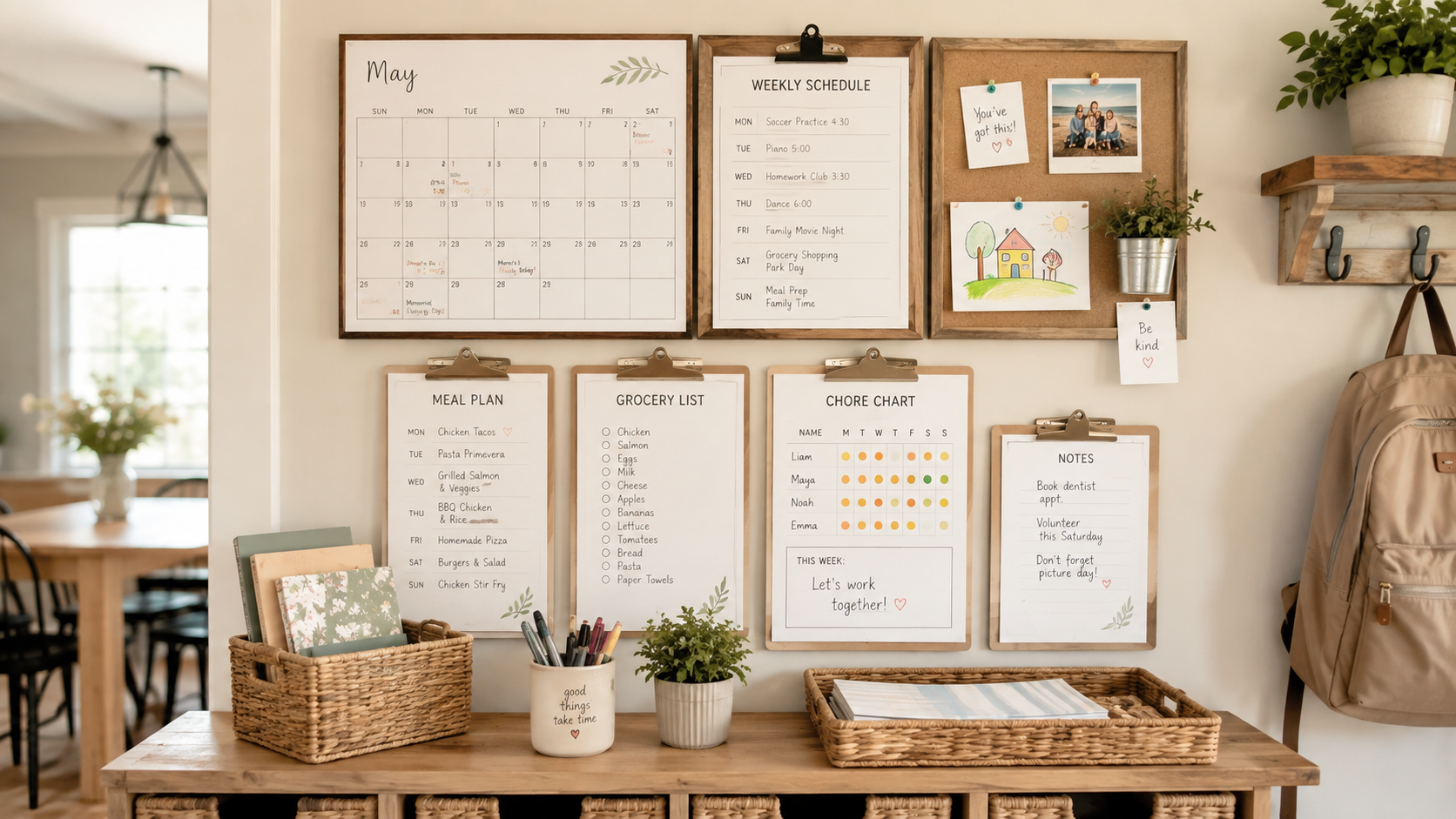
Keeping track of everything your family has going on can feel like a full-time job. Between school schedules, appointments, meal planning, chores, bills, activities, and endless reminders, it is easy for important details to get lost.
A family command center gives all of that information one organized home.
The good news is that you do not need an expensive wall system or complicated organization setup to create one. With a few basic supplies and the right printables, you can build a family command center that works for your household, your space, and your routines.
What Is a Family Command Center?
A family command center is a designated space where your household keeps important schedules, lists, reminders, papers, and planning tools.
Think of it as the headquarters for everyday family life.
Your command center might include:
- A family calendar
- Weekly schedules
- Meal plans
- Grocery lists
- Chore charts
- School information
- Important phone numbers
- Bill reminders
- To-do lists
- Notes for family members
The goal is not to create a picture-perfect organization system. The goal is to create one central place where everyone can quickly find the information they need.
Choose the Right Location
Before printing anything, decide where your family command center will live.
Look for a location your family naturally passes throughout the day. Good options include:
- A kitchen wall
- The side of the refrigerator
- A hallway
- A mudroom
- Near the family entrance
- Inside a pantry door
- Near backpacks and school supplies
- A small desk or counter area
The best location is usually somewhere visible and easy to access.
Avoid placing the command center in an area that family members rarely use. A beautifully organized command center will not help much if no one remembers to look at it.
Start With a Family Calendar
Your calendar will probably become the heart of your command center.
Use a printable monthly calendar to record major family events such as:
- Doctor appointments
- School events
- Sports practices
- Birthdays
- Vacations
- Work schedules
- Meetings
- Field trips
- Lessons
- Family activities
Consider assigning each person a different color so that everyone can quickly identify their schedule.
For example, one child might use blue while another uses green. Parents can have their own colors as well.
Keep the system simple enough that everyone understands it.
Add a Weekly Schedule
A monthly calendar gives you the big picture, but a printable weekly planner helps your family manage the details.
A weekly schedule can include:
- After-school activities
- Homework deadlines
- Work commitments
- Practices
- Lessons
- Appointments
- Errands
- Household projects
Updating the schedule once a week can become part of your regular family planning routine.
Sunday evening works well for many families because it gives everyone a chance to see what is coming during the week ahead.
Include a Meal Planning Printable
Meal planning is one of the easiest ways to reduce everyday decision fatigue.
Add a weekly meal planner to your command center and list what you plan to serve for dinner each night.
You can also include breakfast, lunch, and snack ideas if that helps your household.
A visible meal plan means fewer questions about what is for dinner and makes grocery shopping much easier.
Pair your meal planner with a printable grocery list so family members can add items when something runs out.
Create a Family Chore Chart
Household responsibilities are easier to manage when everyone knows what they are responsible for.
A printable chore chart can help divide tasks such as:
- Taking out the trash
- Loading or unloading the dishwasher
- Feeding pets
- Cleaning bedrooms
- Doing laundry
- Setting the table
- Sweeping floors
- Watering plants
You can create daily chores, weekly chores, or a rotating chore schedule.
For younger children, consider using simple words, checkboxes, or pictures.
For older children and teens, a weekly responsibility chart may work better.
Add a School Section
If you have school-aged children, your command center can prevent school papers from taking over the kitchen counter.
Create a section for school-related information such as:
- School calendars
- Homework trackers
- Project deadlines
- Lunch menus
- Testing dates
- Teacher contact information
- Extracurricular schedules
- Permission slip reminders
You can also give each child their own folder or clipboard.
This gives school papers a temporary home until they are completed, signed, filed, or returned.
Use a Printable Family To-Do List
Not every task belongs on a calendar.
A printable family to-do list gives you a place for jobs that simply need to get done.
Your list might include things such as:
- Schedule dentist appointments
- Return library books
- Buy birthday gifts
- Repair a leaky faucet
- Pick up dry cleaning
- Donate old clothes
- Register for activities
Instead of trying to remember everything, write it down where the entire family can see it.
Create a Bill and Payment Reminder
Your command center can also help you stay organized financially.
A printable bill tracker can include:
- Bill name
- Due date
- Amount due
- Payment status
- Confirmation number
Avoid displaying sensitive financial information in a command center that visitors can easily see.
You do not need to list account numbers or passwords. A simple reminder that the electric bill is due on the 15th may be enough.
Add an Important Information Sheet
An important information printable can be helpful, especially in households with children or babysitters.
Consider including frequently used information such as:
- Emergency contacts
- Pediatrician or doctor phone numbers
- School phone numbers
- Trusted neighbors
- Family phone numbers
- Veterinarian information
- Home address
Keep sensitive information secure and only include details that are appropriate to display in your home.
Include a Notes or Message Section
Sometimes you just need a place to leave a quick message.
Add a printable notes page, dry-erase board, or small notepad where family members can leave reminders such as:
“Practice moved to 5:30.”
“We need milk.”
“Package arriving Tuesday.”
“Don’t forget your library book.”
A simple message area can become surprisingly useful.
Put Your Printables in Frames
One of the easiest ways to reuse printables is to place them inside inexpensive picture frames.
Most dry-erase markers will write directly on the glass.
You can print one clean copy of your:
- Weekly planner
- Meal planner
- Chore chart
- Grocery list
- Schedule
- To-do list
Then place the printables inside frames and update them throughout the week.
This keeps you from printing new pages constantly.
Clipboards are another inexpensive option. They make it especially easy to switch out printable pages.
Use Binders or File Folders for Extra Papers
Your command center does not need to display everything.
Use folders, wall pockets, or a small binder for papers that need to be kept nearby but do not need to be visible.
Consider creating folders labeled:
- To Sign
- To File
- School
- Bills
- Activities
- Coupons
- Important Papers
This helps prevent loose paperwork from piling up on tables and countertops.
Keep Supplies Nearby
Your command center will be much easier to use when basic supplies are readily available.
Consider keeping a small container nearby with:
- Pens
- Pencils
- Highlighters
- Dry-erase markers
- Sticky notes
- Paper clips
- Scissors
You may also want a small basket for incoming mail or papers that need attention.
Don’t Add Too Many Printables at Once
It can be tempting to create an elaborate system with dozens of planners and trackers.
Start small instead.
Choose the three or four printables your family would use most often.
A simple starter command center might include:
- Monthly calendar
- Weekly schedule
- Meal planner
- Grocery list
- Chore chart
Use those for a few weeks before deciding whether you need anything else.
A simple system your family actually uses is much more effective than a complicated one everyone ignores.
Create a Weekly Command Center Reset
Your command center works best when you maintain it regularly.
Choose one day each week for a quick reset.
During your reset:
- Update the family calendar.
- Review the upcoming week’s appointments.
- Add school and activity schedules.
- Plan meals.
- Update the grocery list.
- Assign or rotate chores.
- Remove outdated papers.
- Add new reminders.
This does not have to become a long planning session.
Even 10 or 15 minutes spent updating your command center can make the week feel more manageable.
Make It Work for Your Family
There is no single correct way to build a family command center.
A household with toddlers will need a very different system from a household with teenagers.
Your command center should reflect your family’s actual routines.
If nobody uses a chore chart, remove it.
If you constantly need a school schedule, make it more prominent.
If meal planning is your biggest challenge, give that section more space.
The best organization systems change as your family changes.
Helpful Family Command Center Printables
If you want to build your own system, consider including printables for:
- Monthly family calendar
- Weekly family schedule
- Meal planner
- Grocery list
- Chore chart
- Cleaning schedule
- Homework tracker
- School activity schedule
- Family to-do list
- Bill tracker
- Important contacts
- Appointment tracker
- Family goals
- Notes and reminders
You do not need every printable on this list. Choose the ones that solve problems your household actually experiences.
Final Thoughts
A family command center is not about making your home perfectly organized. It is about making everyday life easier.
By keeping schedules, meals, chores, reminders, and important information in one central location, your family spends less time searching for information and more time knowing what needs to happen next.
Start with a few simple printables, put them somewhere your family already gathers, and adjust your system as you discover what works.
Over time, your family command center can become one of the most useful organization tools in your home.
Subscribe to our newsletter and receive a free 7 day reset planner.